Construction Knowledge Bank
Document Management
Construction Document Management Best Practices
Use Back button ← on your browser to return to previous menu


Use Back button ← on your browser to return to previous menu
How to create a single source of truth that improves collaboration, reduces risk and keeps construction projects on track.
Every construction project depends on information. Drawings, specifications, Requests for Information (RFIs), submittals, contracts, variations, site diaries, inspection records and defect reports all play a critical role in delivering the work.
The challenge is ensuring that every project participant has the right information at the right time. When information is fragmented across emails, shared drives and personal folders, confusion follows. When teams work from outdated drawings, approvals are delayed and costly rework becomes more likely.
Effective construction document management creates a controlled environment where project information remains accurate, connected and accessible throughout the project lifecycle. It is about managing information—not simply storing files—so office and site teams can make decisions confidently from a single source of truth.
This article explains the principles of effective construction document management, the common challenges contractors face and the practical best practices that improve collaboration, reduce risk and support successful project delivery.
Construction projects involve many organisations working at the same time. Owners, architects, engineers, consultants, contractors, subcontractors and suppliers can all create, receive and act on project information. A decision made by one party can affect several others, often across different trades and locations.
A revised structural drawing, for example, may change fabrication, procurement and installation activities. If the revision is not distributed quickly—or if an obsolete drawing remains in use—the consequences can include rework, delays and disputes over responsibility.
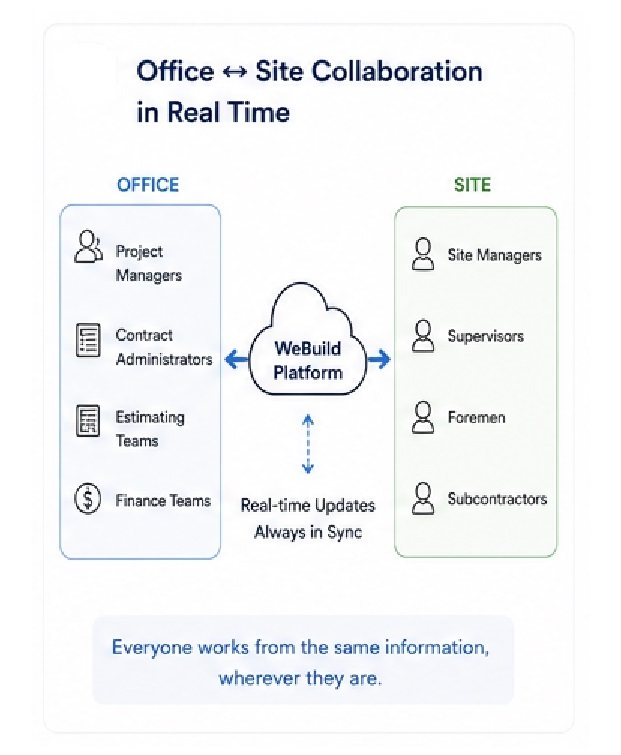
Good document management reduces this risk by creating clarity around what information is current, who has access to it, and how changes are approved and recorded. It also improves collaboration between office and site teams. Project managers and contract administrators can issue information centrally, while supervisors and other authorised project participants can access current documents wherever the work is taking place.
Construction document management is the structured process of creating, receiving, organising, reviewing, approving, distributing, revising and archiving project information throughout the construction lifecycle.
It may include drawings and specifications, RFIs, submittals, contracts and variations, meeting minutes, transmittals, site diaries, inspection records, quality and safety documentation, photographs, defect records and handover information.
Storing and retrieving documents is only part of the task. Effective document management must also preserve their status, history and context. Users should be able to determine whether a document is current, when it was revised and who issued or approved it.
This broader approach aligns with modern information-management principles. ISO 19650, for example, provides a framework for exchanging, recording, versioning and organising information across the lifecycle of built assets.
The objective of construction document management can be summarised in three words: accurate, connected and accessible.
Project teams must be confident they are working from the latest approved information. Revision histories, document status, approval workflows and audit trails help establish that confidence. If users cannot tell which drawing is current, the document management process has failed at its most basic level.
Construction documents rarely exist in isolation. A drawing may be referenced by an RFI, changed following a consultant response, supported by a submittal, affected by a variation and later referenced during an inspection or defect review. Connecting these relationships creates a more complete project record and gives each document context.
The right people need access to the right information when they need it. That may be in the office, on site or working remotely. Accessibility does not mean unrestricted access; permissions should control who can view, upload, revise or approve information. The aim is to remove unnecessary barriers without losing control.
Together, these three principles turn document management from an administrative filing function into an active project-control process.
Many organisations still think of document management as a digital filing cabinet: create folders, upload files and make them searchable. Centralised storage is important, but modern construction projects demand more.
Consider a revised services drawing. The change may originate from an RFI raised on site, lead to a consultant response, revised drawing, subcontractor submittal and contract variation, and later be referenced during an inspection or defect review.
These are not separate pieces of information. They form a connected chain of project decisions and actions.
When information is managed in separate inboxes, spreadsheets and systems, these relationships are difficult to follow. A person may see the latest drawing without understanding why it changed or what other processes were affected.
Connected information provides context. Users can follow the history of an issue, understand related decisions and locate supporting records without reconstructing events from multiple sources. A single source of truth is therefore not simply one place to store files, but a controlled environment where information remains connected to the workflows that created and used it.

Every controlled construction document moves through a lifecycle. The exact process varies by document type and project requirements, but the underlying stages are generally similar.
A document enters the project information environment. It should be clearly identified using agreed naming, classification and revision conventions.
The document is checked by the appropriate parties. Comments, decisions and approvals should be recorded so the status of the document is clear.
Approved information is issued to the relevant project participants. Distribution records or transmittals help demonstrate what was sent, to whom and when. The audit trail records the date and time recipients received and downloaded the information.
Office and site teams use the current information to plan, coordinate and carry out work. Obsolete versions should not compete with current documents for attention.
When information changes, a new revision is issued through the same controlled process. The revision history should remain available for traceability.
At project completion, records are retained in an organised form for handover, maintenance, compliance, claims and future reference.
Version control, permissions and audit trails run through every stage. Together they protect the integrity of the information and provide a reliable history of project activity.

Most document management problems are not caused by a lack of documents. They are caused by a lack of control over where information is stored and how it moves through the project.
Common challenges include multiple drawing versions, information scattered across email and shared drives, inconsistent file names, delayed approvals, unclear document ownership and documents disconnected from related workflows.
These problems create friction. Staff waste time finding information or confirming whether it is current. Site teams wait for answers, and decisions become difficult to trace. In a dispute, teams may need to reconstruct events from emails rather than rely on a clear project record.
The solution is not greater complexity. It is a consistent process supported by a clear allocation of responsibilities and appropriate technology.
Store controlled project information in one central environment. Team members should know where to find current documents and should not need to search through email attachments or personal folders.
Use consistent naming conventions, document types and folder or register structures. A logical system makes information easier to find and reduces reliance on individual knowledge.
Every revision should be identifiable and the current version clearly distinguished from superseded information. Revision history should show how the document has changed over time.
Establish who is responsible for reviewing, approving and issuing different types of documents. Clear workflows reduce delays and prevent unauthorised information from being treated as approved.
Use role-based permissions so project participants can access the information relevant to their responsibilities. External collaborators should be able to participate in controlled workflows without compromising document security.
Link drawings and files to related RFIs, submittals, variations, transmittals, inspections and defects. This preserves context and creates a more complete audit trail.
Updates should be available to authorised site users as soon as current information is issued. Avoid parallel systems where the office maintains one set of records and site teams rely on downloaded or emailed copies.
Do not wait until handover to organise project records. Consistent document control throughout the project makes archiving, handover and future retrieval significantly easier.
Construction document management is about far more than organising files. Its purpose is to ensure project information remains accurate, connected and accessible throughout the construction lifecycle.
When teams can trust the information they use, find it when needed and understand how it relates to project decisions, collaboration improves and risk is reduced. Office and site teams remain aligned, and the project develops a reliable record of what happened and why.
The goal is not more administration. It is simple, consistent control that makes project information easier to manage and use. Modern construction management platforms can support these principles by bringing documents, workflows and project participants into a connected information environment.
Ultimately, good document management gives project teams something fundamental: confidence that they are working from the right information.

